St Martins’ Submission to the National Cultural Policy Consultation
22 May 2026
As Australia shapes its next National Cultural Policy, St Martins is proud to support calls for children and young people to be placed at its heart through a sixth pillar dedicated to their creative development.
Arts and culture play a vital role in nurturing imagination, creativity and innovation. Investing in young people means recognising them not only as the leaders of tomorrow, but as contributors and changemakers today.
We look forward to working with organisations across the country to help make this vision a reality.
Here is our submission as part of the National Youth Arts Network:
Thank you for the opportunity to contribute to the next iteration of the National Cultural Policy. We deeply appreciate having our voice heard, and by extension, the voices of the young artists we work with every day.
For over 45 years, St Martins Youth Arts Centre has worked inclusively with children and young people aged 5 -18 as artists, collaborators and cultural citizens. We write to advocate for stronger recognition of Youth Arts within Australia’s national cultural framework and to highlight the unique and essential role the sector plays in Australia’s cultural ecology, wellbeing and future creative workforce.
Youth Arts is not an adjunct to the arts sector. It is foundational infrastructure.
Across Australia, Youth Arts organisations are often the first place where young people encounter meaningful artistic practice, develop creative voice, technical skill, collaboration and leadership, and begin pathways into the broader cultural sector. These organisations nurture young artists, audiences, arts workers and cultural leaders.
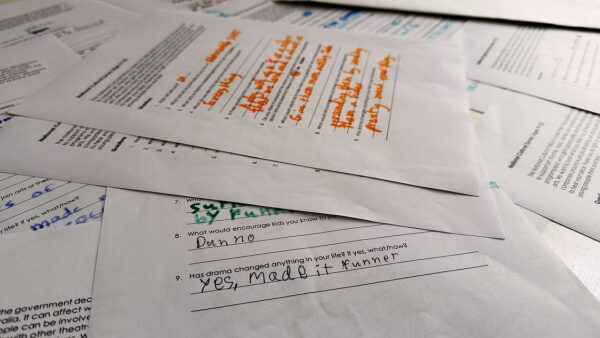
At St Martins, young people are not treated as passive recipients of arts education. They are recognised as artists now. Through long-term engagement with professional practitioners, diverse children and teenagers participate in the creation of contemporary performance work that reflects their own experiences, imaginations and perspectives. St Martins productions over recent years have received five major Green Room Awards, a further 12 nominations and industry accolades across the country. Our model is rare in Australia and increasingly vital, resulting in both artistic excellence and personal transformation for the young people. As part of this submission, we surveyed all of our young people aged between 9 and 18. Every single one,100%, said it was important that young people’s voices are included in Australia’s Cultural Policy.
Reading the responses from our young people left us inspired and in awe. Has taking part in our programs changed anything in your life? “Yes! It has shaped my life, interests, personality and moral character;” “It has caused me to deeply grow into who I am as a person and discover my voice and love for life;” “Yes, it’s given me courage and life skills from learning how to perform and share my voice.”
The current national conversation about young people frequently centres around crisis: declining mental health, disconnection, loneliness, disengagement from learning and increasing social fragmentation. St Martins and Youth Arts organisations around the nation respond to these challenges every day through creative practice that builds belonging, confidence, agency and intergenerational connection.
Australian and international research* consistently demonstrates that arts participation improves wellbeing, resilience, educational engagement and community connection, highlighting the important role Youth Arts organisations play within Australia’s prevention and early intervention landscape.
However, Youth Arts should not be valued solely for its social outcomes. It is also a critical artistic and cultural investment. Without Youth Arts, Australia risks weakening the very pipeline that sustains our storytelling industry and cultural identity. Youth Arts organisations create spaces where young people can imagine, question, collaborate and express complex ideas about the world around them while building belonging, resilience and artistic voice. Many young people who engage in Youth Arts continue on to contribute to Australia’s major companies, festivals and institutions, while others carry these creative capacities into broader community and professional life.
To that end, Youth Arts remains structurally under-recognised within national funding systems. Youth Arts organisations are often assessed against frameworks designed for unrelated models, including venues, presenters, community services or adult arts companies, despite serving a distinct and highly specialised function.
Victoria’s experience illustrates this clearly. Organisations such as St Martins have played an enduring role in developing generations of artists and audiences, while simultaneously creating spaces for participation, experimentation and contemporary performance-making with young people. Yet there remains no dedicated national funding stream that adequately recognises Youth Arts as both artistic practice and essential cultural infrastructure.
We therefore strongly support the following recommendations as distilled by the National Youth Arts Network:
- 1. Include Children and Young People as a pillar of the National Cultural Policy.
- 2. Establish a sustained national funding stream for children and young people’s arts organisations that recognises their role in artistic development, cultural leadership, and as a critical pipeline for the future arts workforce and major cultural institutions.
- 3. Establish a separate cross-portfolio funding stream for youth arts participation and engagement, co-managed alongside Health, Education, Employment, Youth Justice and Social Services, to support programs that improve wellbeing, social connection, learning, inclusion and community participation through arts engagement.
- 4. Establish a standing Youth Advisory Committee for Creative Australia that is managed independently by the Youth Arts sector, and reflects the diversity of young Australians, ensuring they have a direct voice in cultural decision-making.
Youth Arts organisations operate at the intersection of artistic excellence, participation, education and social connection. They are small in scale compared to major institutions, yet their impact across generations is profound.
If Australia wishes to sustain a vibrant, diverse and internationally respected cultural sector, investment in Youth Arts cannot remain peripheral. It must be recognised as essential national cultural infrastructure.
Young people are not only the future of Australian culture. They are active contributors to it now.
Nadja Kostich
Artistic Director and CEO
St Martins Youth Arts Centre
* (Ewing, 2010; Fancourt & Finn, 2019; Zarobe & Bungay, 2017; Victorian Health Promotion Foundation, 2015) REFERENCE: Ewing, R. (2010). The Arts and Australian Education: Realising Potential. Australian Council for Educational Research. ACER publication page Fancourt, D., & Finn, S. (2019). What is the evidence on the role of the arts in improving health and well-being? A scoping review (Health Evidence Network synthesis report No. 67). World Health Organization Regional Office for Europe. WHO report PDF Victorian Health Promotion Foundation. (2015). VicHealth Mental Wellbeing Strategy 2015-2019. VicHealth. VicHealth strategy PDF Zarobe, L., & Bungay, H. (2017). The role of arts activities in developing resilience and mental wellbeing in children and young people: A rapid review of the literature. Perspectives in Public Health, 137(6), 337-347. https://doi.org/10.1177/1757913917712283